Clinical Case 14
When Implant Angulation Changes the Attachment Design
Rehabilitation of both arches with implant-retained, tissue-supported overdentures: a bar-ball design in a maxilla with divergent implants and independent ball attachments in the mandible
This case involved a 58-year-old woman who presented with several concerns: unstable prostheses, difficulty chewing, and dissatisfaction with appearance.
All eight implants were already present before referral and had been placed without prior prosthodontic-prosthetic consultation and planning. There were four implants in each arch, but that did not mean the two arches should receive the same design. Implant number is only one variable in treatment planning; implant position and angulation, available prosthetic space, the path of insertion, and the way an attachment will actually function can constrain or change the restorative options.
In this patient, those differences led to two different solutions for the maxilla and mandible.
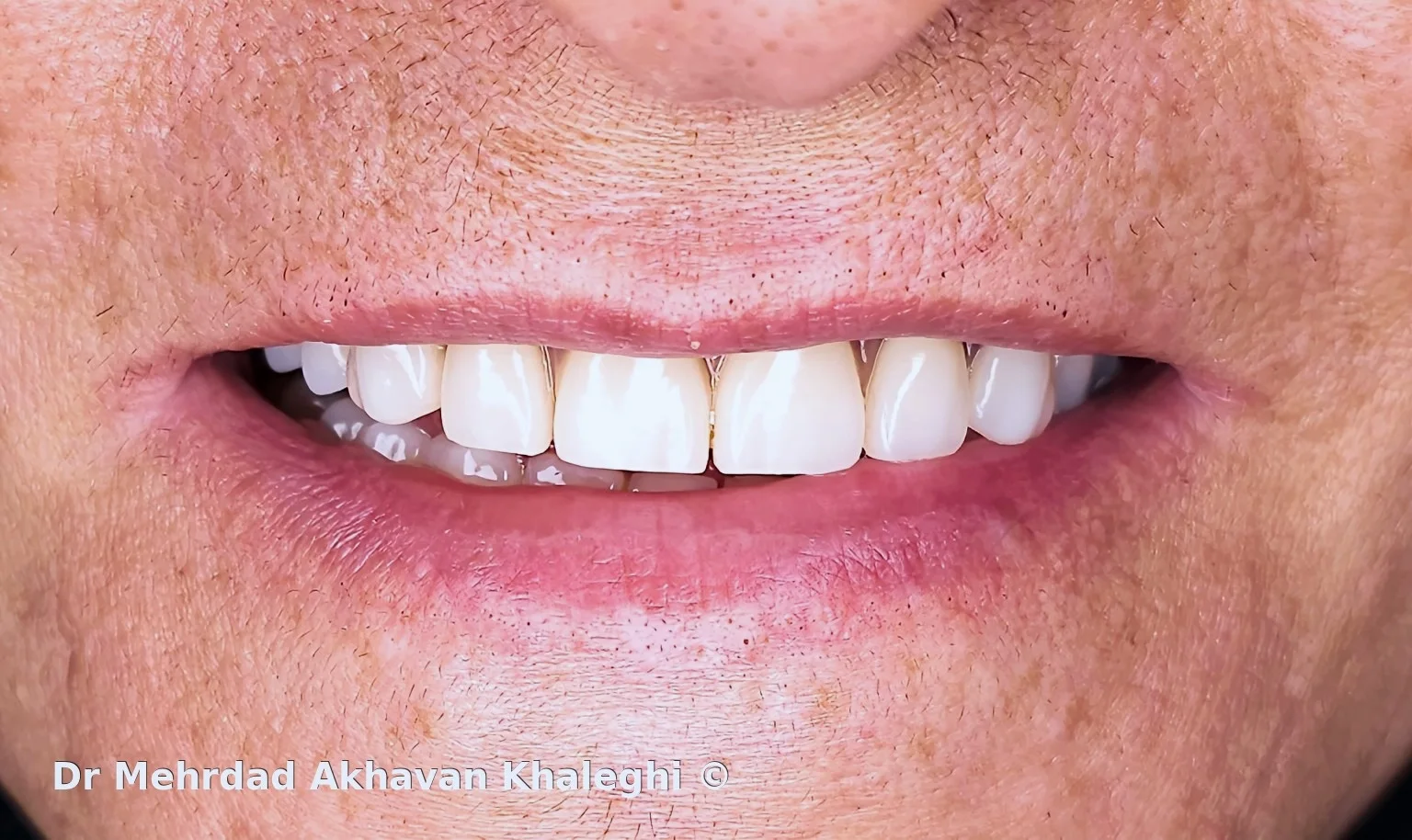
Maxilla
When four implants do not mean four independent ball attachments
The pre-existing maxillary implants showed substantial divergence, which limited straightforward and predictable use of independent attachments.
If independent ball attachments had been placed directly on those implants, establishing a favorable common path of insertion would have been difficult, and cap engagement could have become incomplete and less predictable.
The question was not simply that there were “four implants.” What mattered more was the geometric relationship among those four implants.
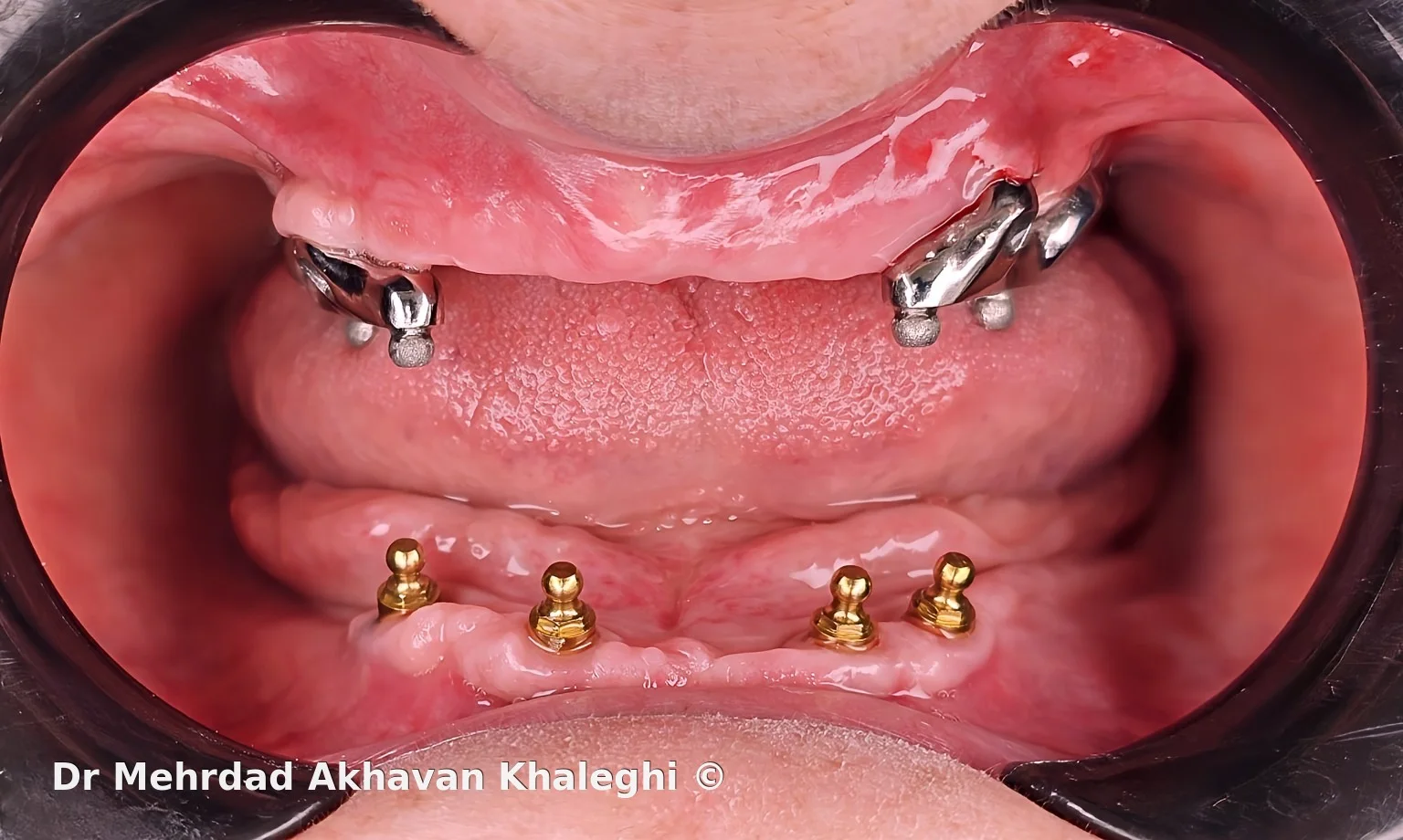
For that reason, the maxillary implants were splinted with a bar, and four ball attachments were incorporated into the bar. This allowed the position and orientation of the attachments to be controlled independently of the unfavorable angulation of the individual implants, creating a more manageable geometry for prosthesis insertion and engagement of the retentive components.
This does not mean that ball attachments are unsuitable whenever implants are divergent. The degree and direction of divergence, the attachment system, and the overall prosthetic design all matter. In this patient, given the actual geometry of the four implants, splinting them and positioning the ball attachments on a bar was the more reliable solution.
Mandible
When there is no reason to make the design more complex
The mandible also had four implants, but the situation was different.
Their angulation was compatible with independent ball attachments, and the available prosthetic space permitted that design. There was therefore no reason to connect the mandibular implants with a bar merely to make both arches look conceptually similar.
Four independent ball attachments were used.
This difference between the two arches is one of the central lessons of the case: the attachment system should not be selected first and then imposed on the patient’s anatomy and implant positions. The design should follow the actual clinical situation.
Biomechanics
Implant-retained, but tissue-supported
In both arches, the prostheses were designed as implant-retained, tissue-supported overdentures.
The principal role of the attachments was retention, while support was provided mainly by the mucosa and residual ridge.
That distinction matters biomechanically. The presence of four implants does not automatically convert an overdenture into a fully implant-supported restoration. The attachments still have to be considered within a tissue-supported design, and base extension, adaptation, and force distribution remain important.
Vertical Dimension
This was not only about the teeth
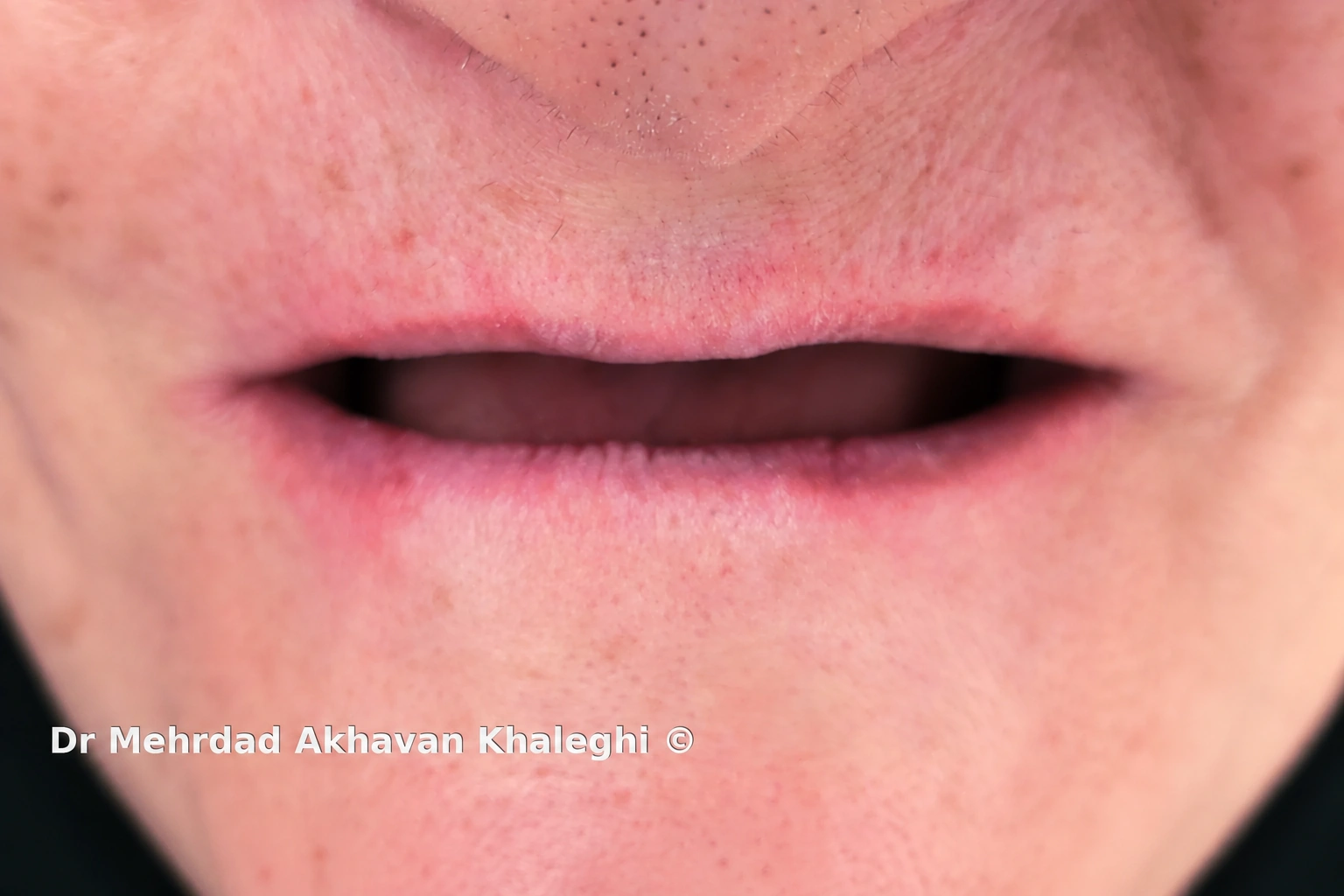
The patient also presented with reduced vertical dimension, and angular cheilitis was clinically visible at the oral commissures.
After the prostheses were reconstructed and the vertical dimension was restored, subsequent photographs showed a clear improvement in this area.
This observation is educationally important, but it should not be turned into an overly certain cause-and-effect claim. Angular cheilitis is multifactorial, and reduced vertical dimension is only one possible predisposing factor.
In this patient, however, the improvement at the commissures after restoration of VDO was consistent with the recognized relationship between overclosure, changes in the folds at the corners of the mouth, and angular cheilitis.
Restoring vertical dimension in this case was therefore not only an esthetic decision or a matter of tooth height; it was also part of restoring function and support for the perioral tissues.
Attachment Design
One patient, two different geometries
The difference between the two arches is visible in a single intraoral view: in the maxilla, the divergent implants were splinted with a bar and four ball attachments were positioned on the bar; in the mandible, four independent ball attachments were used directly on the implants.
The goal was not to make the two systems look alike. The goal was to use the simplest defensible design for the actual geometry of each arch.
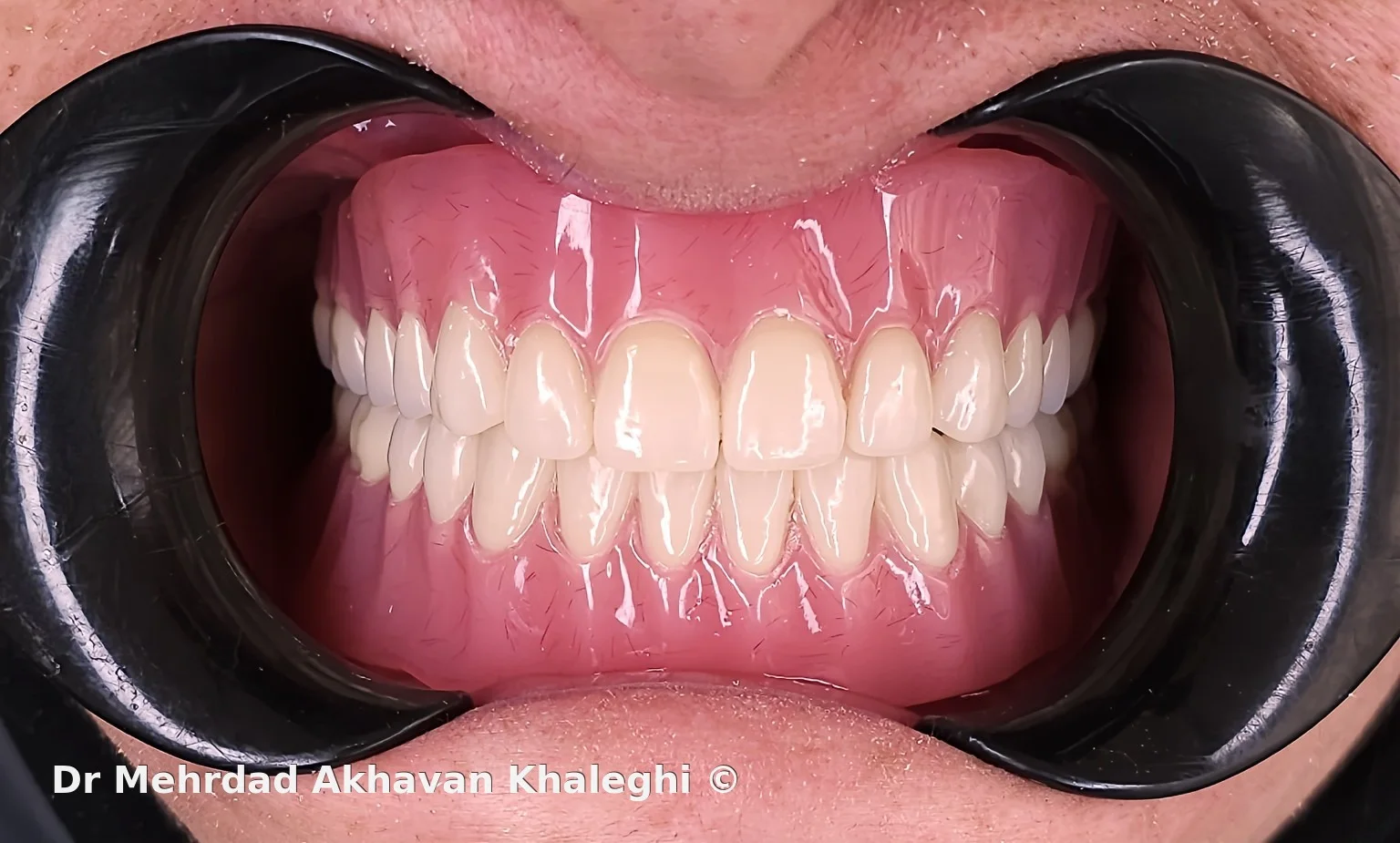
Structure and Occlusion
Rigidity and bilateral balanced occlusion
Both overdentures incorporated a metal framework to provide greater rigidity.
The occlusal scheme was designed as bilateral balanced occlusion, with bilateral contacts during eccentric movements intended to support the stability of the removable prostheses.
Here again, BBO is not presented as a universal prescription for every patient. It was part of the design selected for these two tissue-supported prostheses.
Five-Year Follow-up
Maintenance is part of the treatment outcome
The patient was followed for approximately five years.
The principal maintenance event during this period was replacement of the maxillary ball-attachment caps. No other major problem was reported.
This part of the case is important because it offers an opportunity not only to report the clinical outcome, but also to reconsider aspects of the design itself.
The maxillary bar in this patient was fabricated through a wax-up and casting workflow. Prefabricated Rhein patterns were used during the wax-up, but even when prefabricated components are incorporated, wax-up and casting remain processes in which small dimensional changes and inaccuracies can occur.
It is not possible to conclude from cap replacement alone that fabrication inaccuracy was the cause of the maintenance requirement. It is only one plausible explanation.
If I were treating a similar case today, I would strongly consider a milled bar designed to accept prefabricated, replaceable ball attachments. That approach can provide tighter control over attachment geometry and make future replacement of worn components more straightforward.
That does not mean the method used in this patient was wrong. The rehabilitation performed acceptably and remained maintainable over five years. What changed was my thinking: a treatment can work well and still teach us how to design the next one more precisely.
Conclusion
Implant number alone does not determine the design
The value of this case is not the number of implants.
There were four implants in each arch, yet the two arches were not treated in the same way.
In the maxilla, implant divergence made splinting the implants with a bar and positioning four ball attachments on that bar the more appropriate solution. In the mandible, implant angulation and available prosthetic space allowed four independent ball attachments, with no need to make the treatment more complex.
Both prostheses remained tissue-supported, incorporated metal frameworks, and were designed with BBO. Restoration of vertical dimension was also accompanied by visible improvement of the angular cheilitis, in addition to the functional and esthetic changes.
During long-term follow-up, replacement of the maxillary caps was not treated simply as a complication to be recorded and forgotten. It became an opportunity to reconsider the limitations of the fabrication method and to think about a more controlled milled-component design for future treatments.
In implant overdenture treatment, the number of implants alone does not determine the prosthetic design. Sometimes what matters more is where those implants are positioned, how they are angled, and how the selected attachment will actually function within that geometry. Implant position is a surgical decision with long-term prosthetic consequences.