Clinical Case 6
Maxillary Anterior Rehabilitation: When One Treatment Alone Is Not Enough to Achieve Final Harmony
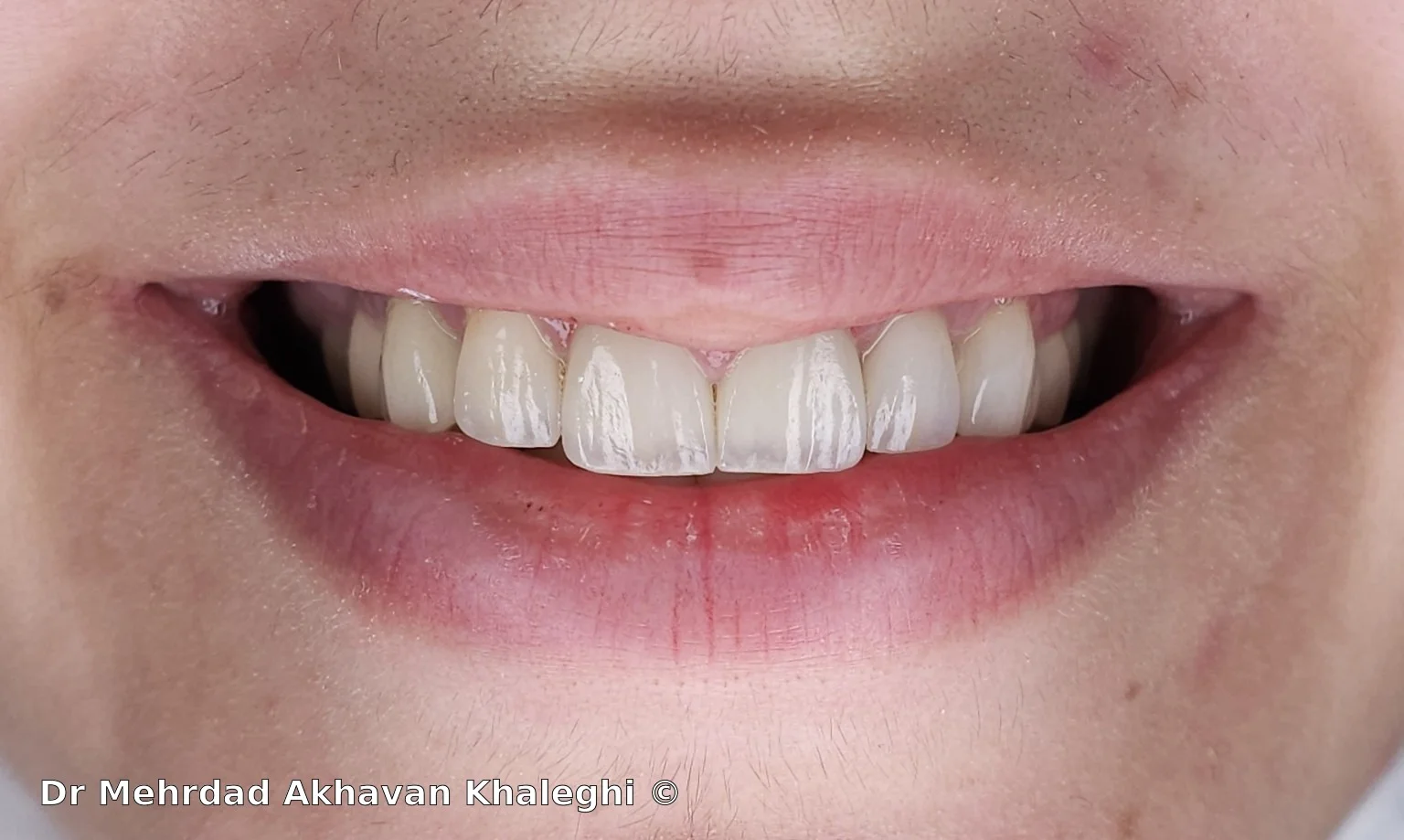
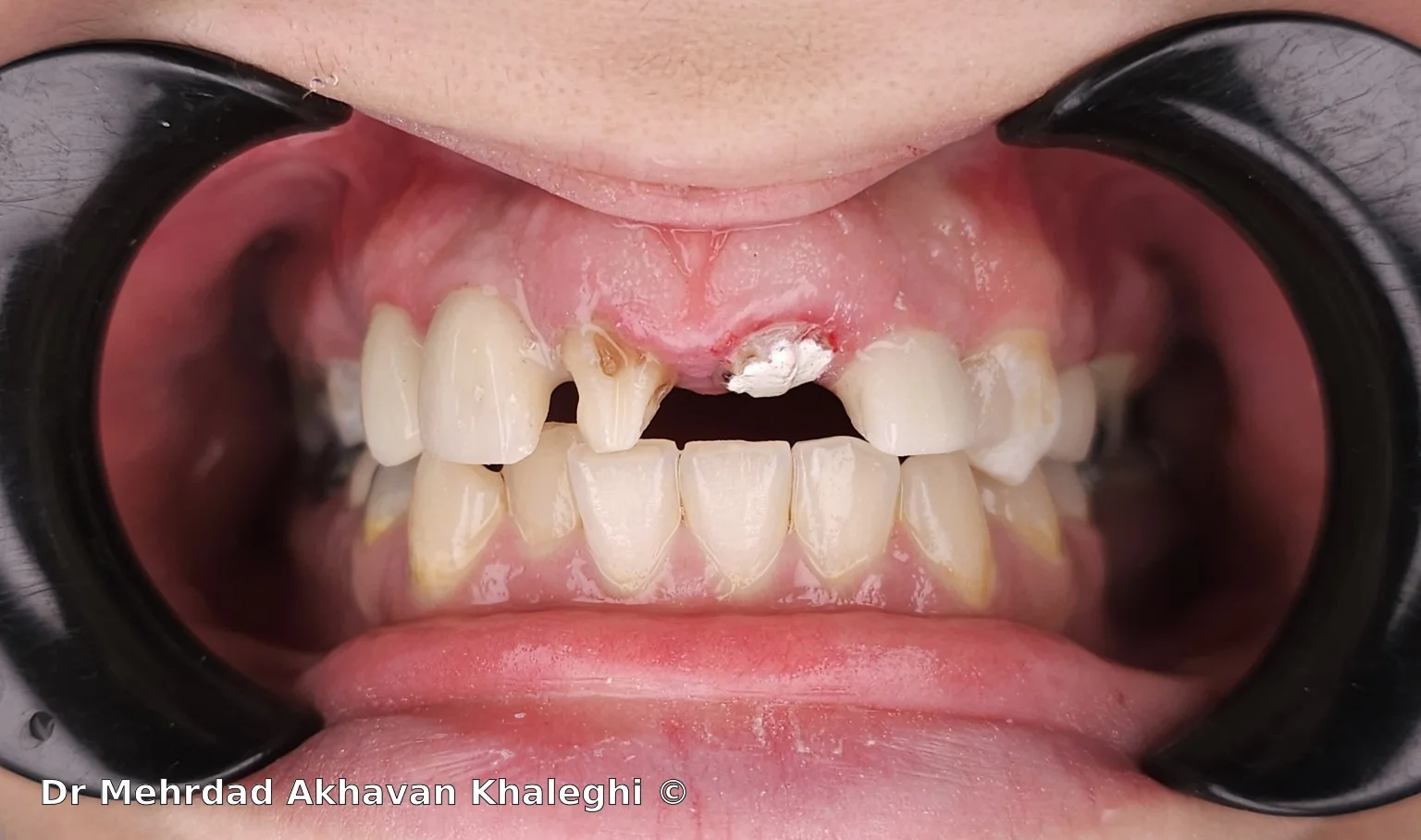
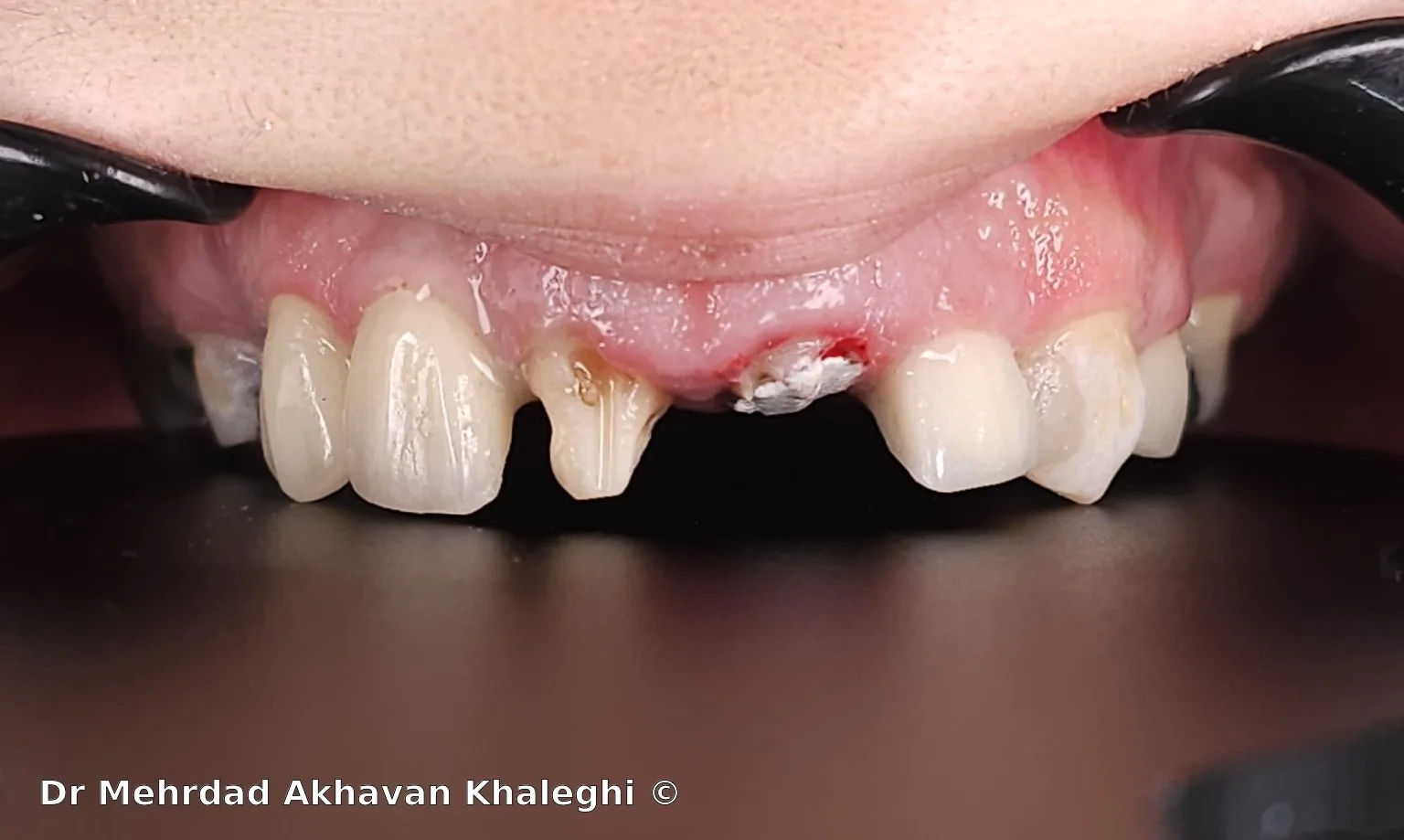
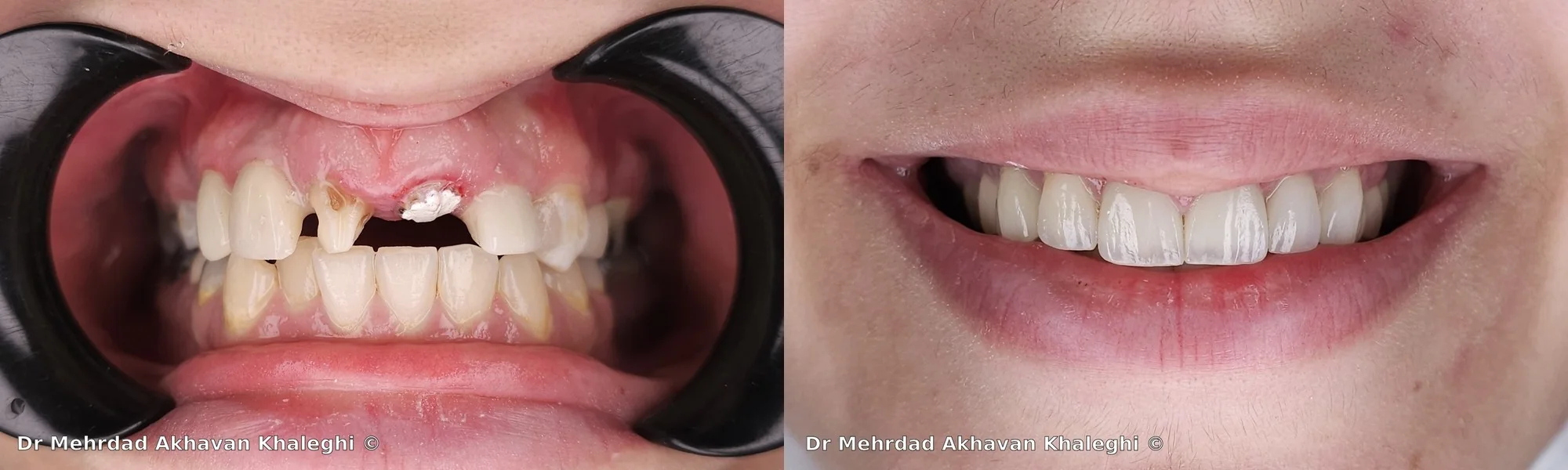
A 29-year-old woman presented with esthetic concerns about the maxillary anterior teeth together with functional complaints. At first glance, the problems were concentrated within a relatively limited region. Beneath that single visual problem, however, were very different clinical conditions: caries and unsatisfactory composite restorations, endodontic treatment that required correction, varying degrees of structural compromise, and two implants at sites 12 and 22 whose fixtures remained serviceable although their prosthetic restorations were unsatisfactory.
The central challenge was to create a result that looked and functioned as one coherent reconstruction even though each tooth—and each implant site—started from a different condition. A consistent final result does not require every site to be treated in the same way. In some cases, coherence depends on making different decisions for different structures and then integrating them into a single restorative outcome.
Treatment decisions
One region, but not one treatment
Teeth 14 and 13 required crowns. Tooth 11 underwent endodontic retreatment and was rebuilt with a fiber post and composite core. Because tooth 21 had extensive structural destruction, primary endodontic treatment and a cast post-and-core were performed. Tooth 23, by contrast, could be managed more conservatively and received an e.max ceramic laminate veneer.
These different interventions reflected the condition of each tooth rather than a desire for procedural uniformity. The degree of structural loss, endodontic status, and amount of remaining tooth structure differed from site to site, so using the same preparation or restoration type simply because all of the teeth were within the esthetic zone would not have been justified.
The general principle is straightforward: a uniform appearance should not be achieved by imposing unnecessary uniformity on teeth with different clinical needs.
Retaining existing foundations
An unsatisfactory restoration does not necessarily mean an unsatisfactory implant
At sites 12 and 22, the main problem involved the previous prosthetic components rather than the implant fixtures themselves. Osseointegration alone is not sufficient reason to retain an implant; position, peri-implant tissue health, and the feasibility of a defensible prosthetic reconstruction must also be acceptable. In this patient, the fixtures remained clinically usable and the main problem was prosthetic, so retaining them was more rational than explantation and creation of a more complex surgical pathway. Information about the existing implants was also obtained from the previous treating clinician. The previous abutments and crowns were replaced, and the new reconstruction was completed on the retained fixtures.
An unsatisfactory previous treatment can create a tendency to remove the entire reconstruction, but the more useful question is which component is actually deficient. If an implant fixture remains clinically serviceable, an unfavorable abutment or crown alone is not a sufficient reason to remove it.
Retaining these implants did not mean accepting the previous treatment uncritically. The parts that were unsuitable were changed; the parts that still had clinical value were preserved.
Soft-tissue management
Provisionals were more than a bridge to the definitive restorations
Implant provisional restorations at sites 12 and 22 remained in place for approximately two weeks to shape the soft tissues and establish the desired emergence profiles. No contour adjustment was required during that period.
The value of this stage extended beyond tissue conditioning. Once the tissues had stabilized, the provisional contours were digitally scanned, and the provisionals themselves were sent to the laboratory so that information already developed intraorally could be transferred as faithfully as possible to the definitive restorations.
When a satisfactory emergence profile has already been established and tested in the mouth, definitive fabrication does not need to begin again from zero. The form validated during the provisional phase can become part of the information carried forward into the final restoration.
In this case, the provisionals were therefore not simply temporary restorations. They served as the link between soft-tissue shaping and the transfer of that information to the definitive prosthesis.
Definitive restorations
Different foundations, one coherent result
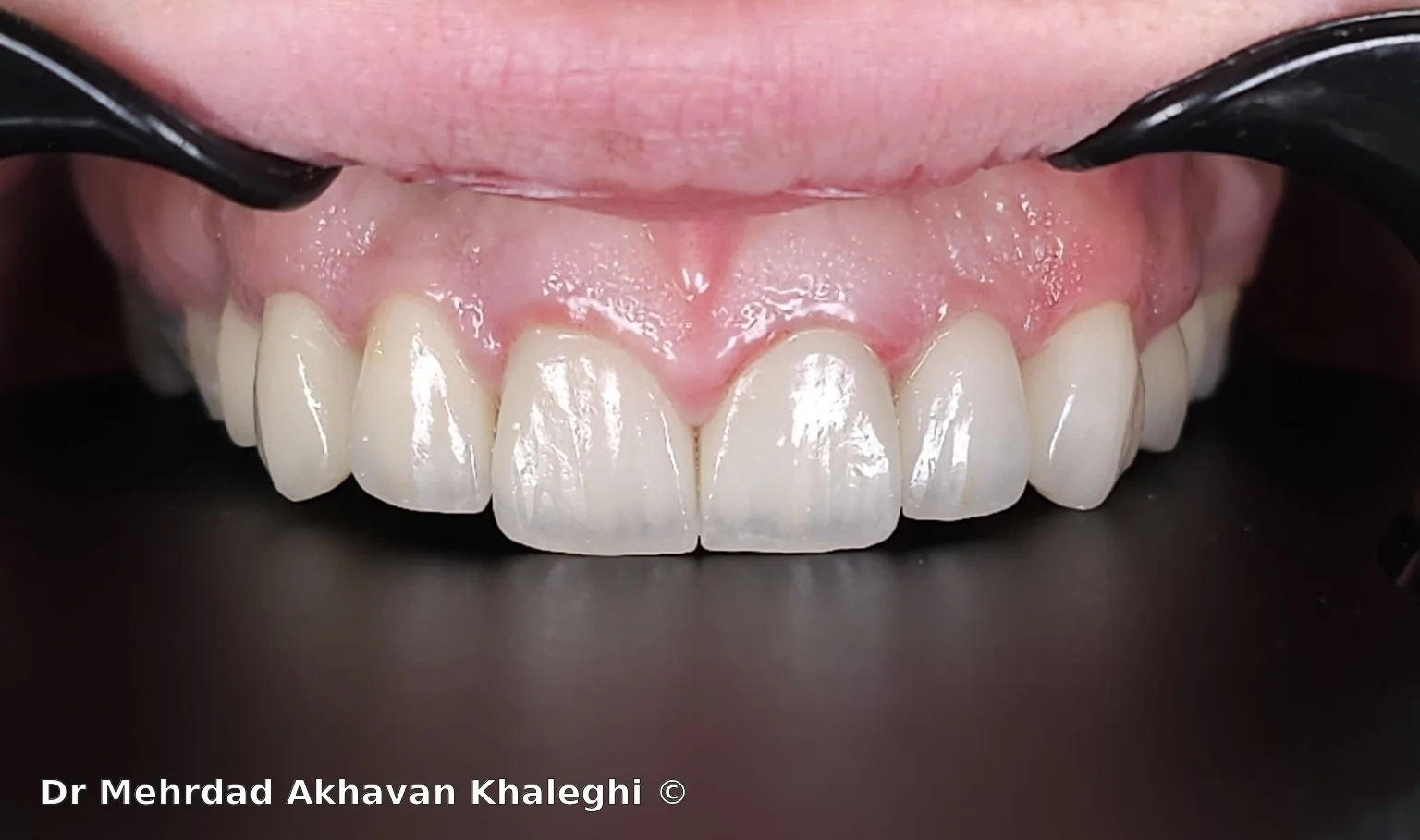
The crowns on teeth 14, 13, 11, and 21, together with the implant crowns at sites 12 and 22, were fabricated in zirconia with e.max ceramic layering. Tooth 23 was restored with a lithium-disilicate laminate veneer.
Behind the final appearance were very different foundations: natural teeth with varying degrees of structural compromise, a fiber post, a cast post-and-core, a laminate veneer, and two existing implants restored with new abutments and crowns.
The objective was not to erase those differences. It was to manage each foundation appropriately so that form, soft-tissue architecture, color, and function could ultimately read as one coherent reconstruction.
The implant crowns were cement-retained, and residual-cement control formed part of delivery. The definitive occlusion preserved the patient’s existing functional relationships with canine guidance. Improving anterior esthetics alone is not an indication to alter functional relationships that do not otherwise require correction.
Follow-up
Four years later: was retaining the existing fixtures a defensible decision?
The patient was followed continuously for approximately four years, with no reported complication involving the restorations or the retained implants during that period.
Four years of follow-up cannot establish that retaining an existing implant is always preferable to replacing it. That decision still depends on the condition of the individual fixture and the surrounding biologic and prosthetic environment. In this patient, however, the uneventful performance of the retained implants over the documented follow-up was consistent with the original decision to preserve them.
Conclusion
Coherence without uniform treatment
The broader value of the case extends beyond the visible result. A coherent reconstruction did not require every component to be treated in the same way.
Some teeth required endodontic treatment and extensive reconstruction; one tooth could be treated more conservatively with a laminate veneer; the implant restorations needed replacement while the fixtures themselves remained serviceable; and the soft-tissue form developed during the provisional phase was transferred to the laboratory rather than recreated from the beginning at the definitive stage.
Conservative treatment is not defined only by reducing tooth preparation. Sometimes the more important skill is distinguishing what genuinely needs to change from what still deserves to be preserved.
Clinical case and photography © Dr Mehrdad Akhavan Khaleghi. Unauthorized use or reproduction prohibited.