Clinical Case 4
Anterior Rehabilitation: When Choosing Not to Treat Is Part of Treatment
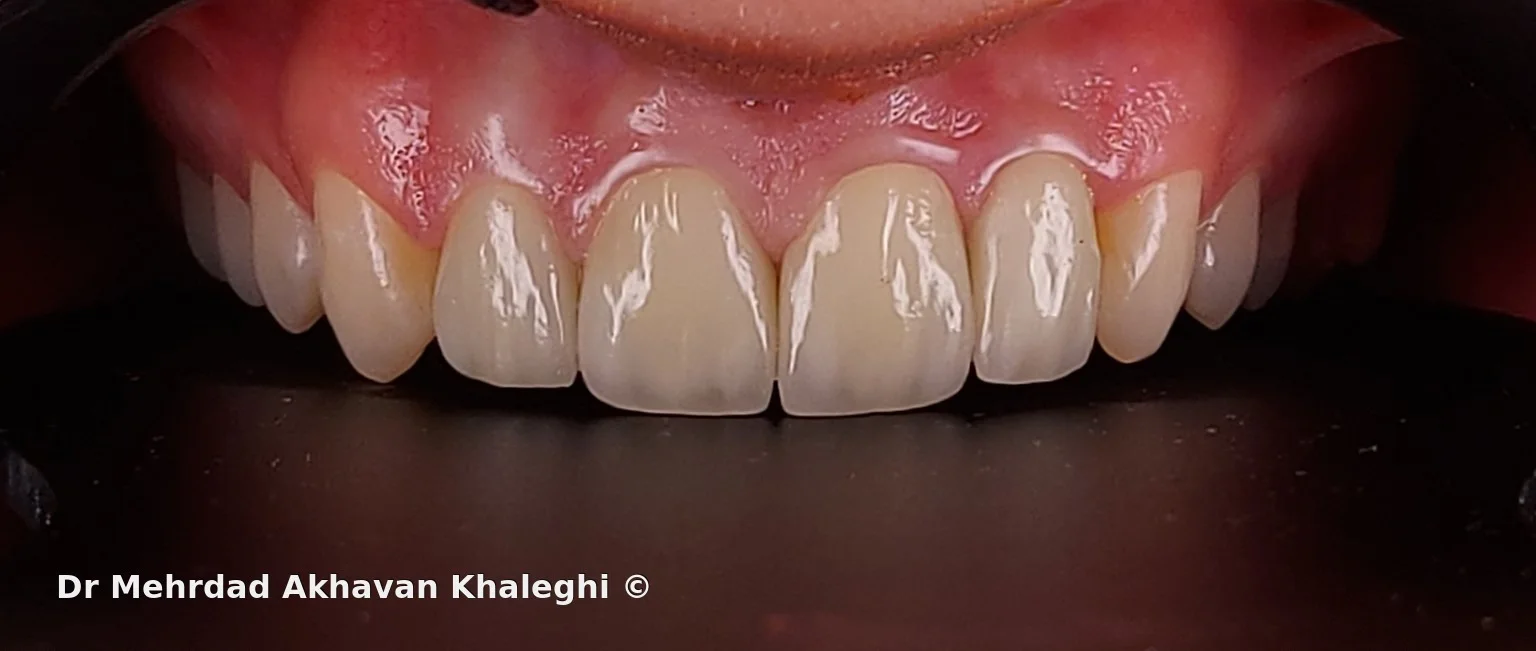
A 19-year-old patient presented with caries, defective composite restorations, and inadequate previous endodontic treatment involving four maxillary anterior teeth. A substantial amount of tooth structure had also been lost, so the problem was not simply the appearance of the existing restorations. Before the form or material of the definitive restorations could be considered, the more important question was how much reliable tooth structure would remain after caries and defective restorations were removed—and whether those foundations were sufficient for a defensible reconstruction.
At the same time, the patient wanted laminate veneers on the canines to create a more uniform smile. From the outset, the case therefore placed two very different questions side by side: four teeth that clearly required treatment, and healthy teeth on which esthetic treatment was technically possible but not necessarily indicated.
Treatment foundation
Before thinking about crowns, the foundation had to be corrected
Once the caries and defective restorations had been removed, the true condition of the remaining tooth structure could be assessed more accurately. The previous root canal treatment in all four teeth was inadequate, so endodontic retreatment was completed before definitive reconstruction.
A well-designed definitive restoration cannot compensate for an unresolved biologic or structural problem beneath it. Placing a technically sound crown over unresolved endodontic disease or an unreliable foundation may conceal the problem, but it does not solve it. Definitive reconstruction therefore began only after the biologic and structural foundations had been addressed.
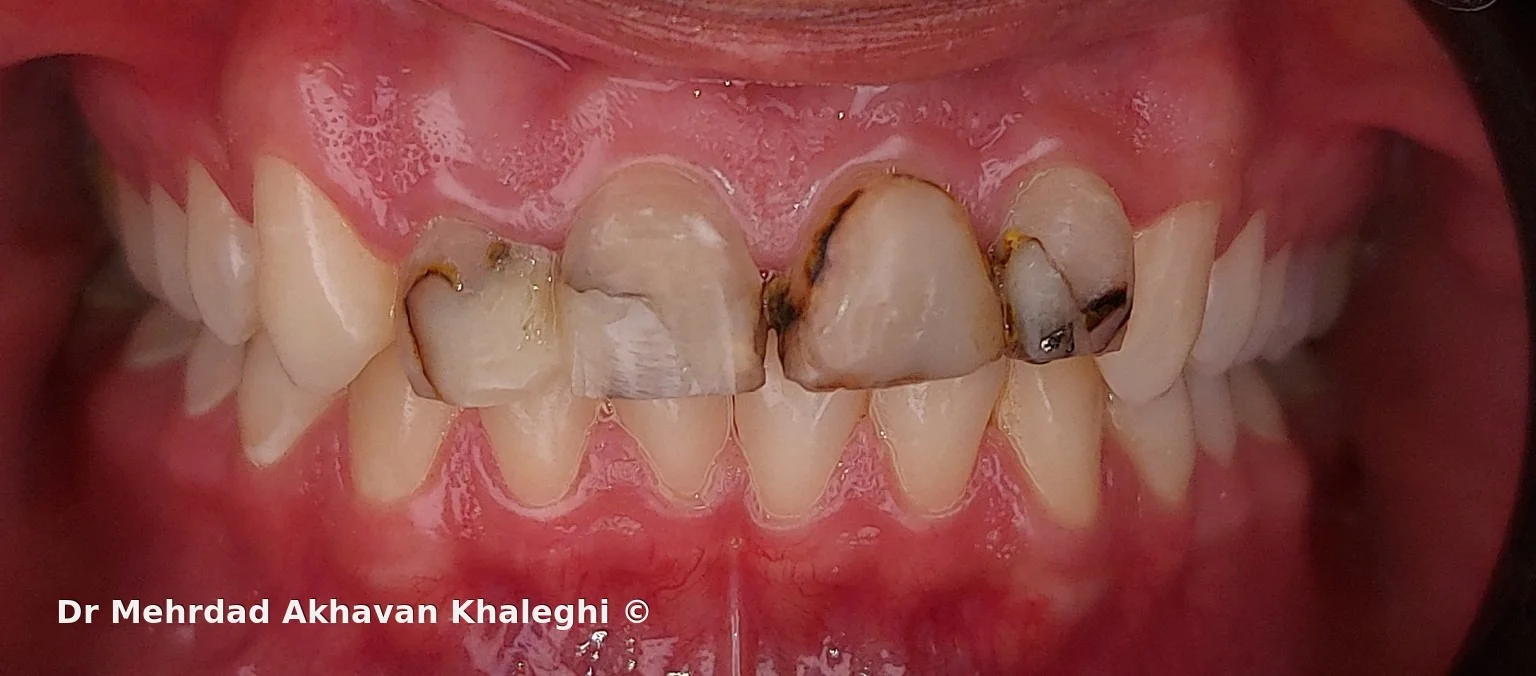
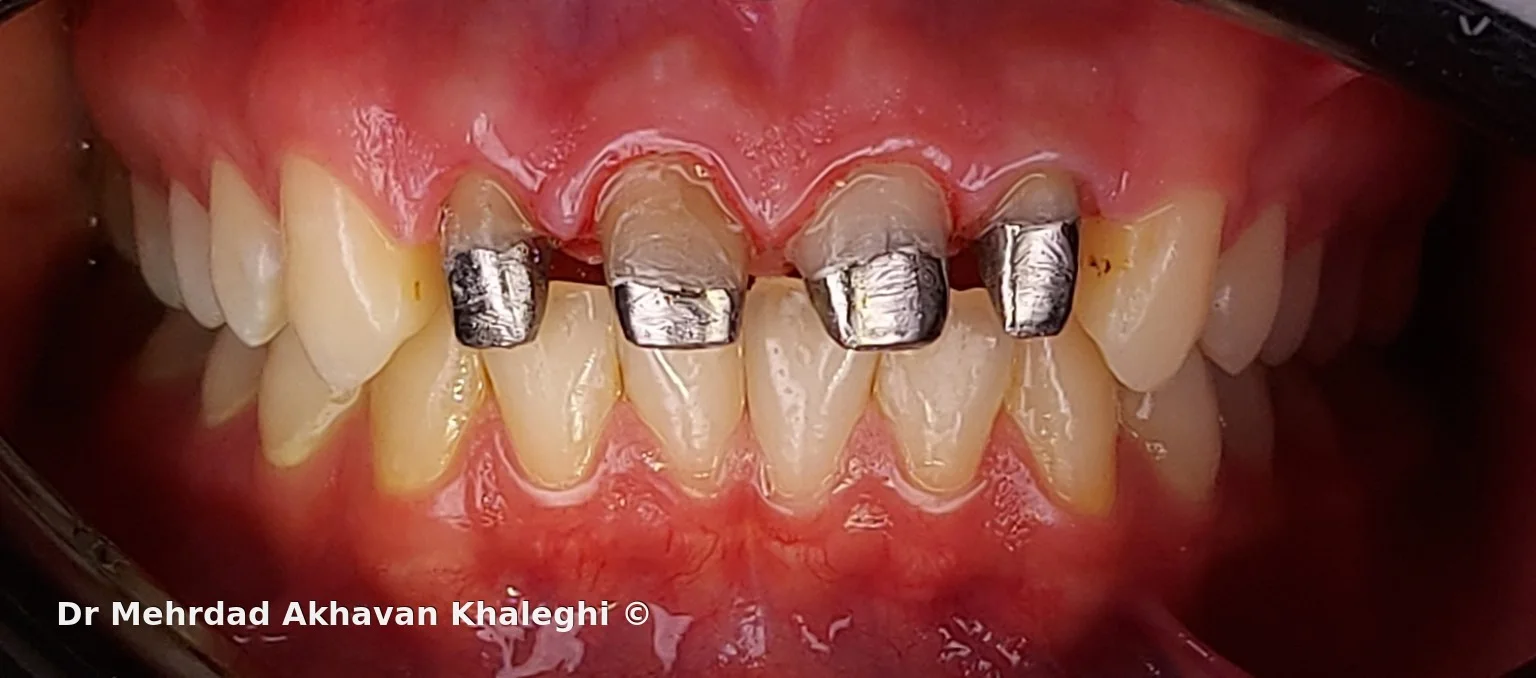
Following retreatment, all four teeth were rebuilt with cast post-and-cores. This was a case-specific decision rather than a claim that cast posts are generally superior to other approaches. Post-and-core selection should be based on the amount and configuration of remaining tooth structure, canal anatomy, retentive requirements, and the planned definitive restoration.
Intervention boundary
Adequate ferrule kept the treatment pathway simpler
After endodontic correction and evaluation of the remaining tooth structure, clinically adequate ferrule was present. Crown lengthening or orthodontic extrusion was therefore not required to create additional structure.
This may appear to be a relatively small detail, but it materially affected the treatment pathway. Crown lengthening and orthodontic extrusion can make a tooth restorable when they are indicated; their availability, however, does not make them necessary. If the remaining structure already provides what the restoration requires, adding further procedures simply because they are possible has no clinical justification.
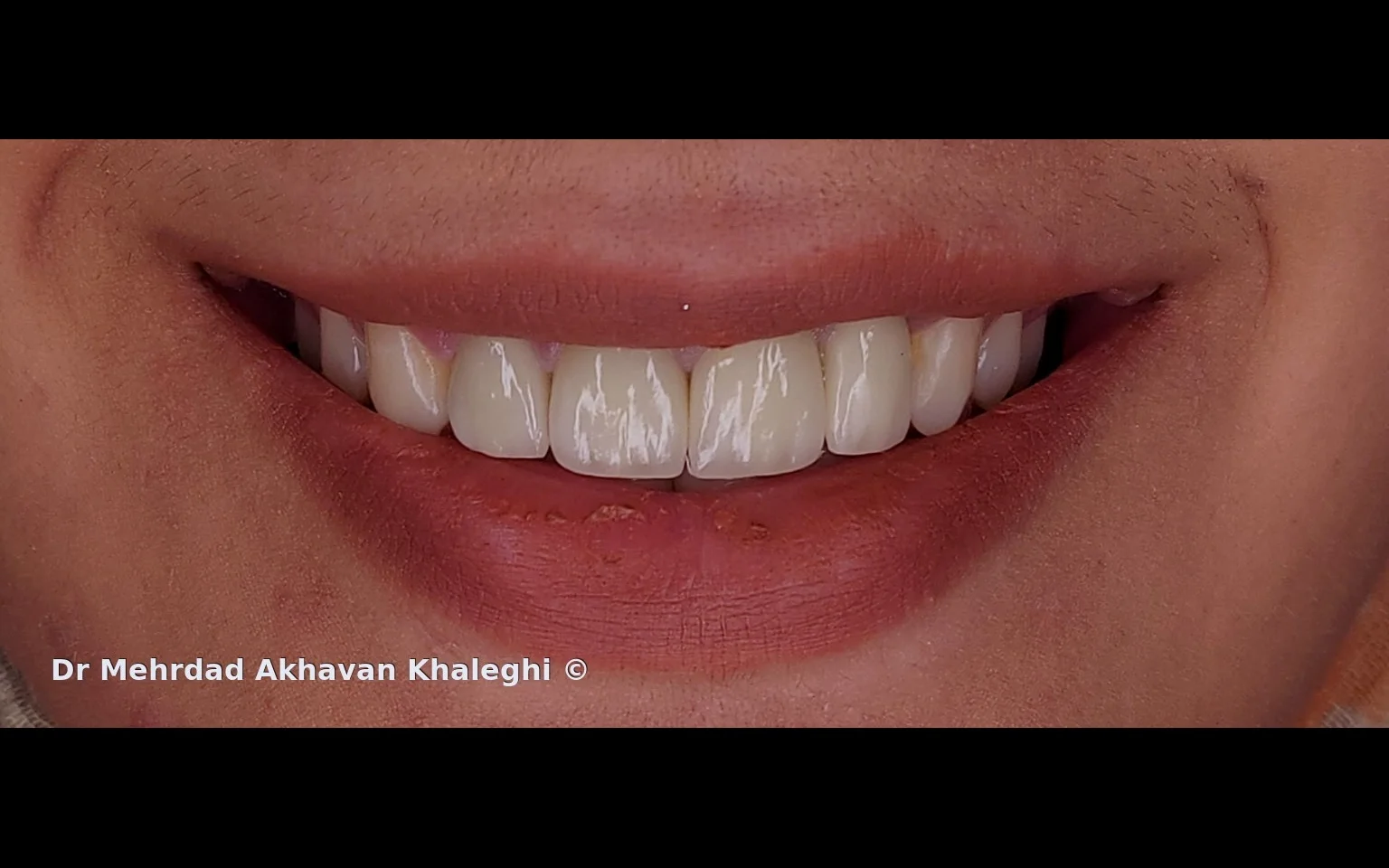
Once the foundations were ready, the four teeth were restored with layered zirconia crowns.
Treatment indication
But the patient wanted two more teeth treated
The canines adjacent to the four compromised teeth were healthy. The patient requested laminate veneers on them to create greater visual uniformity across the smile.
Technically, the treatment could have been performed. Technical feasibility, however, is not the same as treatment indication. Veneer preparation would have required removal of sound tooth structure in teeth that had no clinical problem warranting that intervention.
For that reason, laminate veneers were not recommended and the canines were left unprepared.
This distinction matters more than the material selected for the crowns or the type of post-and-core. Interventions are easy to see because something is prepared, fabricated, and delivered. Clinical judgment is sometimes less visible: the appropriate decision may be to leave a tooth untouched even when treatment is entirely feasible.
Patient preference is an important part of esthetic decision-making, but preference alone does not create an indication. The patient can define the esthetic goal; the clinician remains responsible for determining what that goal would cost in sound tooth structure and whether that biological cost is professionally defensible.
Final integration
Smile harmony should not erase the distinction between healthy and compromised teeth
After the four compromised teeth were reconstructed, the objective was not to extend treatment to the canines simply so that every anterior tooth would be made from the same material or restoration type. The restorations needed to integrate with the healthy natural teeth that remained.
A satisfactory esthetic result may require the restoration to adapt to preserved healthy structure, rather than altering healthy structure to conform to the restoration.
The four anterior teeth required relatively extensive treatment because of their own clinical problems. That fact did not justify moving the treatment boundary onto adjacent healthy teeth.
Follow-up
Approximately six years later: how should the outcome be judged?
According to the available documentation, the patient was followed for approximately six years, with no significant problem reported during that period.
That follow-up cannot be used to establish the superiority of cast post-and-cores or layered zirconia. The outcome of an individual case reflects many variables, including the quality of endodontic treatment, the amount of remaining tooth structure, ferrule, restoration design, occlusion, and ongoing care.
The value of the follow-up is broader than the survival of four crowns. Six years later, the teeth that had a treatment indication had been reconstructed, while the teeth that did not justify preparation remained in their natural form.
Those two outcomes belong to the same treatment result. Success is not measured only by what was done; it also includes interventions that were deliberately not performed.
Not every treatment that is technically possible is an appropriate treatment. One of the clinician’s most important responsibilities is knowing which tooth needs treatment—and which tooth is better left untouched. Clinical judgment is reflected not only in choosing what to do, but also in recognizing what should not be done.
Clinical case and photography © Dr Mehrdad Akhavan Khaleghi. Unauthorized use or reproduction prohibited.