Clinical Case 10
Combined Esthetic Rehabilitation: When One Treatment Does Not Fit Every Tooth
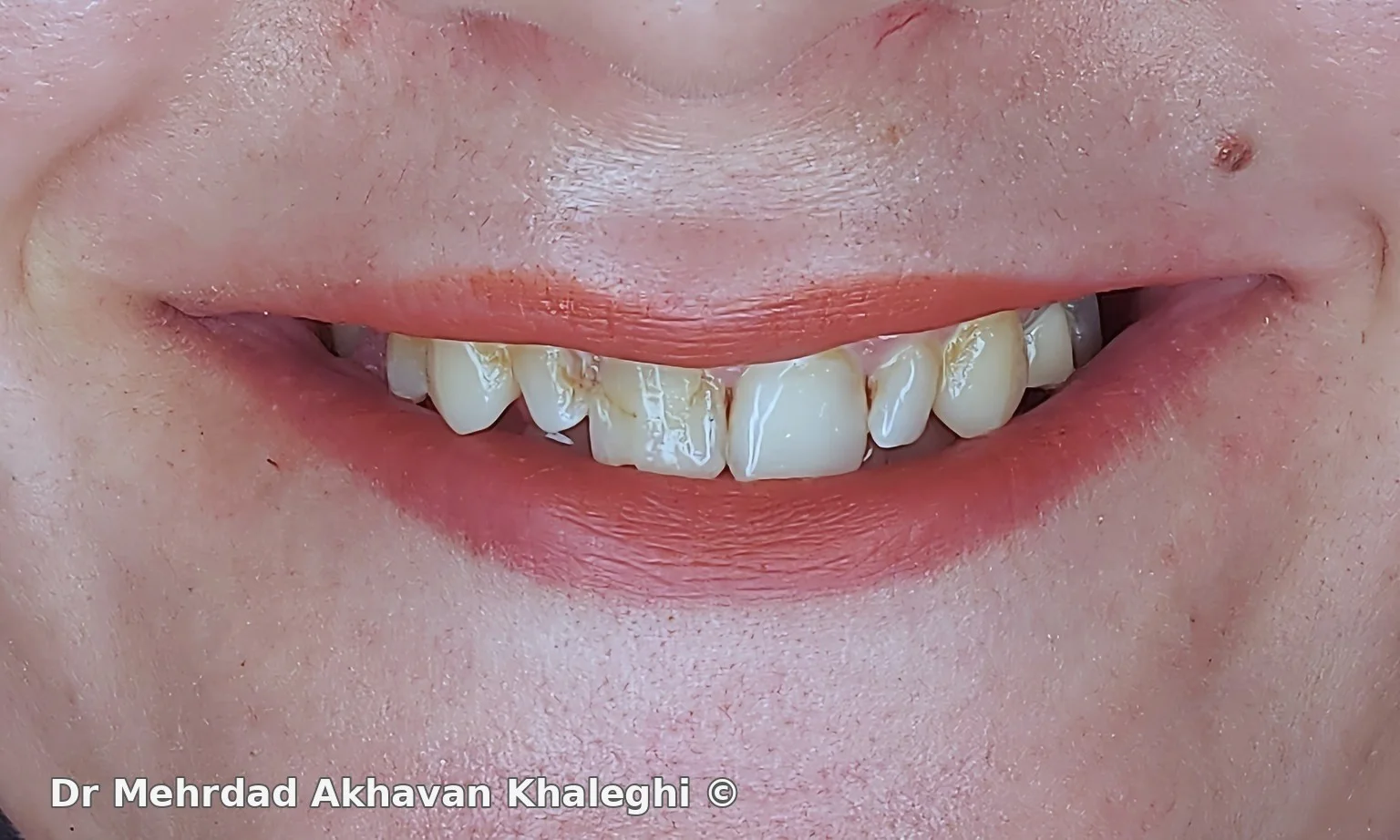
A 42-year-old patient presented with concerns about the color, form, and proportion of the maxillary teeth and wanted a more harmonious smile. At first glance, the case could have been approached as a straightforward esthetic treatment. The teeth, however, did not share the same structural or restorative needs, and that difference became the central planning issue.
The central problem
Coherence does not require identical treatment
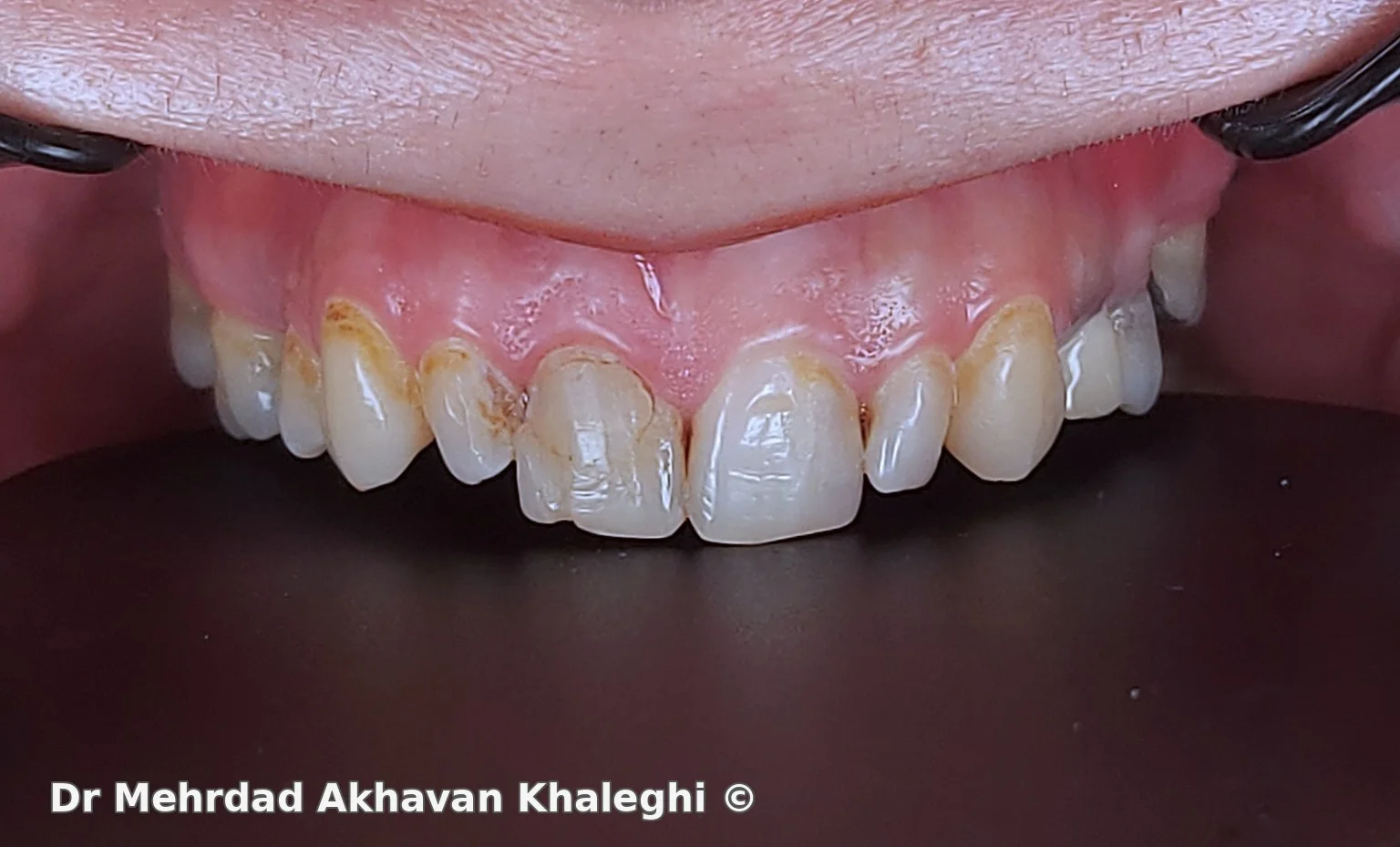
Some teeth were largely intact and required only limited changes in form and color. Others had already been restored or crowned. One tooth had been missing for many years and its space had almost completely closed, while an edentulous site on the opposite side was planned for implant restoration.
The goal, therefore, could not be to select one restorative modality and repeat it across the entire region. The challenge was to choose the least intervention capable of meeting the actual needs of each tooth while still making the different restorations read as parts of one coherent result.
Initial assessment showed anatomically small maxillary lateral incisors, and an unsatisfactory composite restoration on tooth 21 contributed to the anterior discrepancy. The existing crown on tooth 24 was also unacceptable in fit, form, and shade. Tooth 25 had been extracted many years earlier and the space was almost completely closed.
On the right side, site 15 required implant-supported restoration, while endodontically treated tooth 26 required prosthetic coverage.
Under these conditions, using the same restoration on every tooth would not necessarily have made treatment simpler or more conservative. In fact, creating uniformity through one technique could have required unnecessary removal of sound tooth structure.
Planning
Define the endpoint first, then choose the restoration
Before preparation, a diagnostic mock-up was used to evaluate tooth form and proportion, tooth display, smile line, lip support, and phonetics in relation to the face.
The existing occlusal relationships were also assessed. The objective was not to obtain an esthetic result by imposing a new functional scheme. Where the treatment allowed, the established occlusal relationships were intended to be preserved in the definitive reconstruction.
An index and digital scan were obtained from the final mock-up, and tooth preparations were carried out within the volume that had already been designed. The provisional restorations reproduced the same endpoint so that tooth form, lip support, smile line, phonetics, and occlusal relationships could be evaluated clinically again before definitive fabrication.
For me, the value of a mock-up in a case like this is not simply to show the patient a possible smile. It should also help define the treatment boundary: where reduction is truly required and where more tooth structure can be preserved.
Restorative selection
One treatment plan, several restorative modalities
The restorative decision was made tooth by tooth.
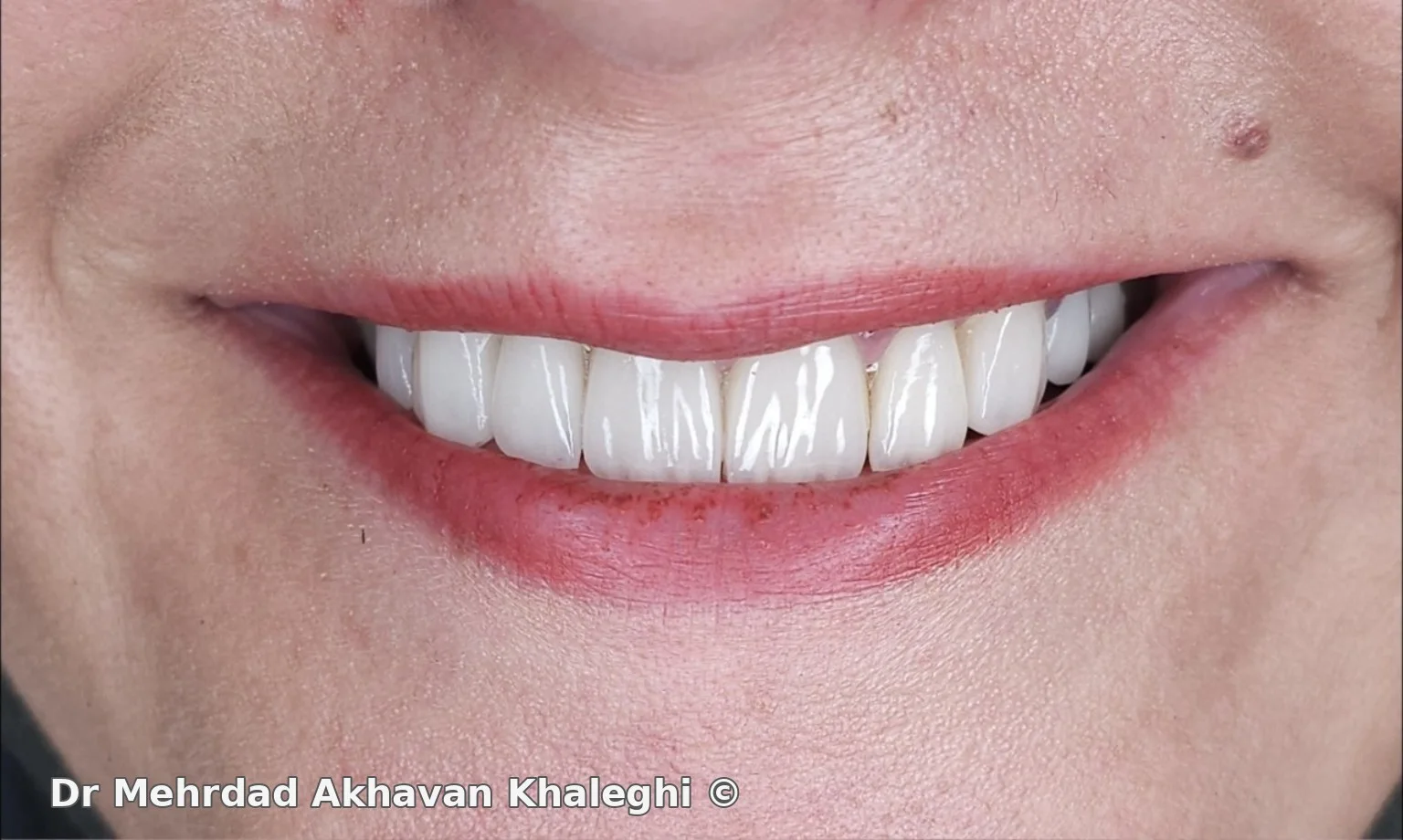
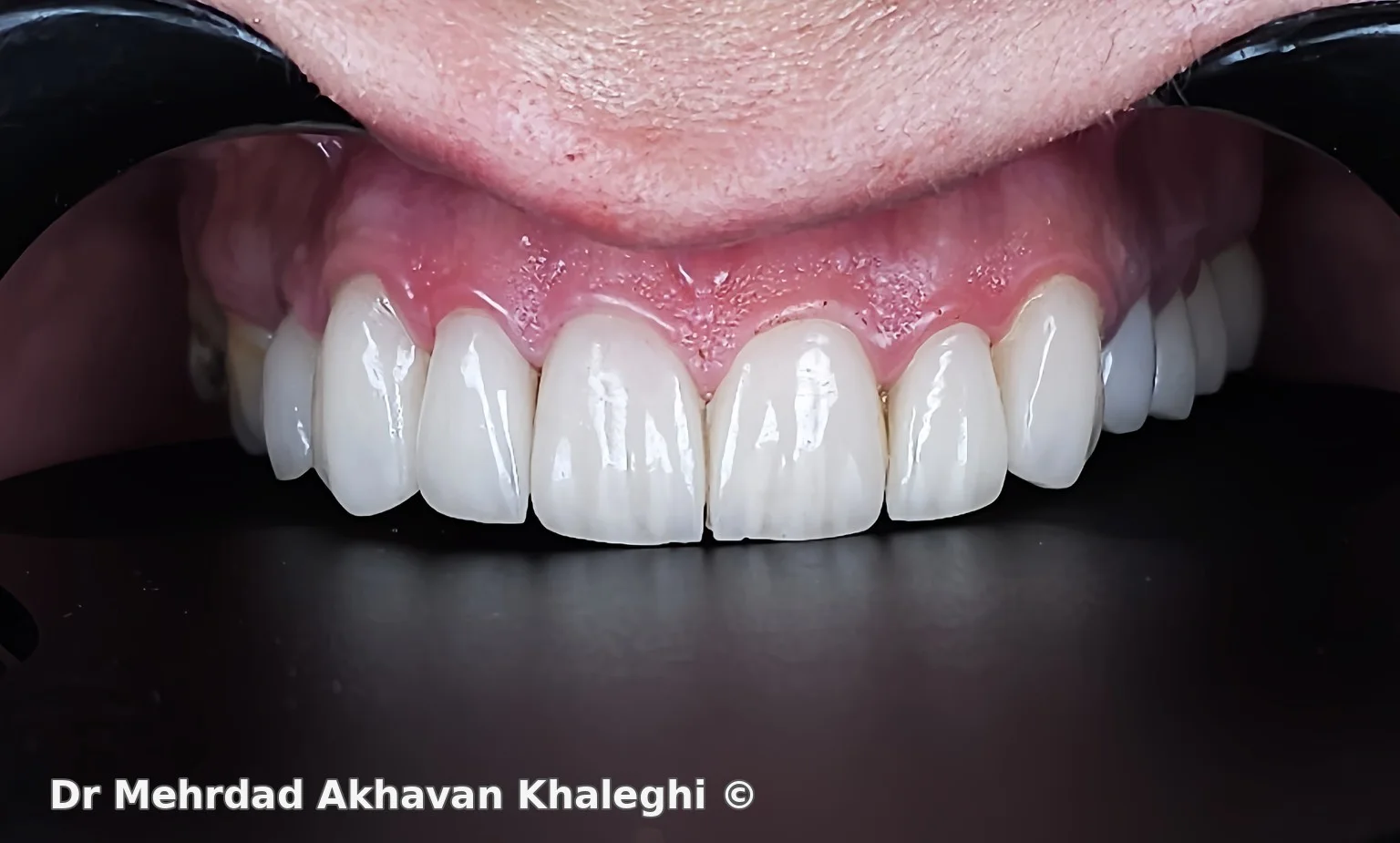
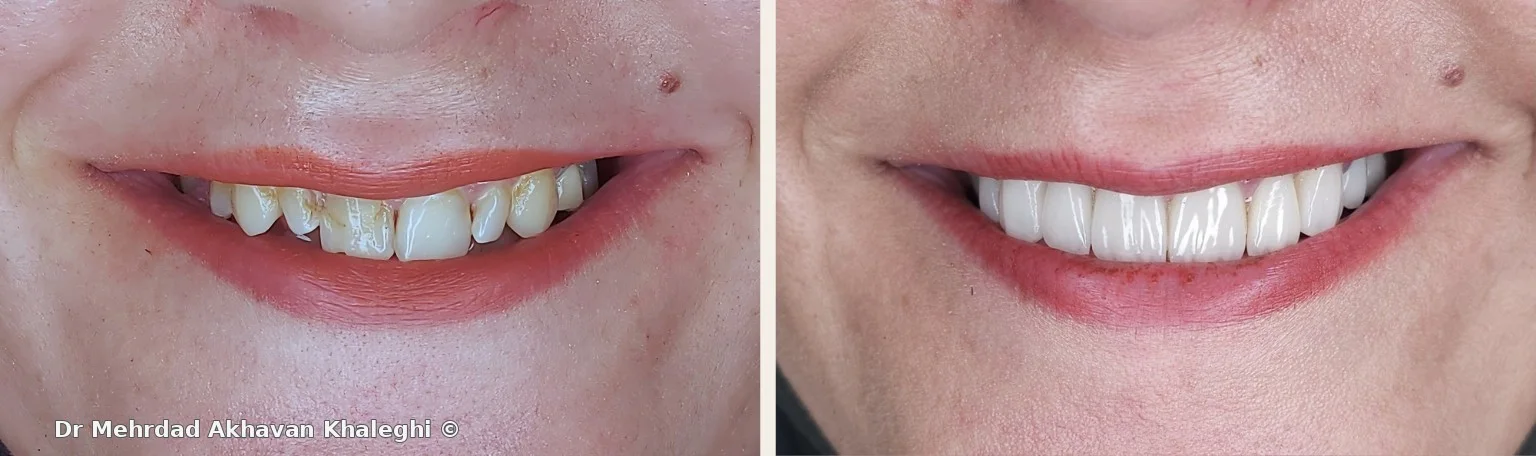
Teeth 23 through 13 were restored with e.max ceramic laminate veneers. The objective in the anterior segment was to correct color, form, and proportion without converting relatively intact teeth to full-coverage restorations merely for uniformity.
Tooth 14 required a broader correction, but full coronal coverage was not necessary. An e.max vonlay was therefore selected. Preparation remained within enamel and was kept as conservative as possible while still establishing appropriate contact with the opposing arch.
The existing crown on tooth 24 was removed. The endodontic treatment and underlying restoration were found to be satisfactory, with no indication for retreatment, and the tooth was restored with a layered-zirconia crown.
Endodontically treated tooth 26 was also restored with a layered-zirconia crown.
At site 15, implant placement had been part of the treatment plan from the outset and was performed by a periodontist. After osseointegration and periodontal confirmation, the site was restored with a layered-zirconia implant crown.
The long-standing space at tooth 25 presented a different problem. Because the tooth had been missing for years and the space had almost closed, reopening a full replacement space was not part of the plan. Continuity and proximal relationships in that region were managed through the contours of the crowns on teeth 24 and 26.
Viewed superficially, the plan was a mixture of laminate veneers, a vonlay, tooth-supported crowns, and an implant crown. The logic behind them was the same: the restoration should follow the condition of the tooth, rather than sacrificing the tooth to fit a preselected restoration.
Treatment outcome
Bringing different foundations into one result
A genuine challenge in this case was that restorations with different substrates and thicknesses had to create one coherent result in color, form, and proportion.
A laminate veneer on a relatively intact tooth, a crown on an endodontically treated tooth, and an implant crown do not share the same optical background or restorative space. The patient, however, does not experience the final result as a list of techniques; it is perceived as one smile.
The definitive restorations were therefore managed as a coordinated phase so that form and shade could be evaluated together. The overall occlusal scheme was not altered, and the pre-existing contacts were reproduced in the definitive reconstruction.
At delivery, the patient approved the restorative form, shade, and functional result. Treatment was completed without a reported complication or a major change to the original plan.
Follow-up
Four years later—with an important limitation
Approximately four years later, after relocating abroad, the patient reported during remote follow-up that there had been no significant prosthetic or functional problem.
That outcome must be interpreted carefully. No long-term clinical examination or radiographic assessment was available after the relocation. This is therefore patient-reported follow-up, not documented clinical follow-up.
The available photographs show the definitive result at the time of treatment and must not be presented as four-year follow-up images.
The absence of a patient-reported problem is reassuring, but it cannot substitute for clinical examination, assessment of margins and periodontal tissues, implant evaluation, or radiographic review.
Conclusion
One coherent plan—not one treatment for every tooth
For me, the value of this case is not the number of restorations or the combination of different materials.
In an extensive esthetic rehabilitation, using one technique across the entire region can be attractive because it may simplify planning and communication. Simplicity for the clinician, however, is not by itself a justification for removing more sound tooth structure.
In this patient, some teeth received laminate veneers, one was treated with a vonlay, others required crowns, and one site was restored with an implant crown. The differences in treatment did not prevent a coherent result. On the contrary, the ability to choose differently allowed the intervention to remain proportional to the needs of each tooth.
Conservative treatment does not mean selecting the least invasive technique available for every tooth. It means choosing, for each tooth, the least intervention that can defensibly meet the needs of that particular tooth. In this patient, that principle required different restorative approaches for different teeth rather than imposing one technique across the entire esthetic zone.
Clinical case and photography © Dr Mehrdad Akhavan Khaleghi. Unauthorized use or reproduction prohibited.